1. The Setup
The Ad
A single Meta in-feed static for Smilodox's Aesthetic Compression Collection, framed as a restock after the line's initial sell-out. Five male models in five colourways stand against a black studio backdrop, flanking a loaded barbell. The headline reads "BIG RESTOCK LIVE!" above a 20% code.
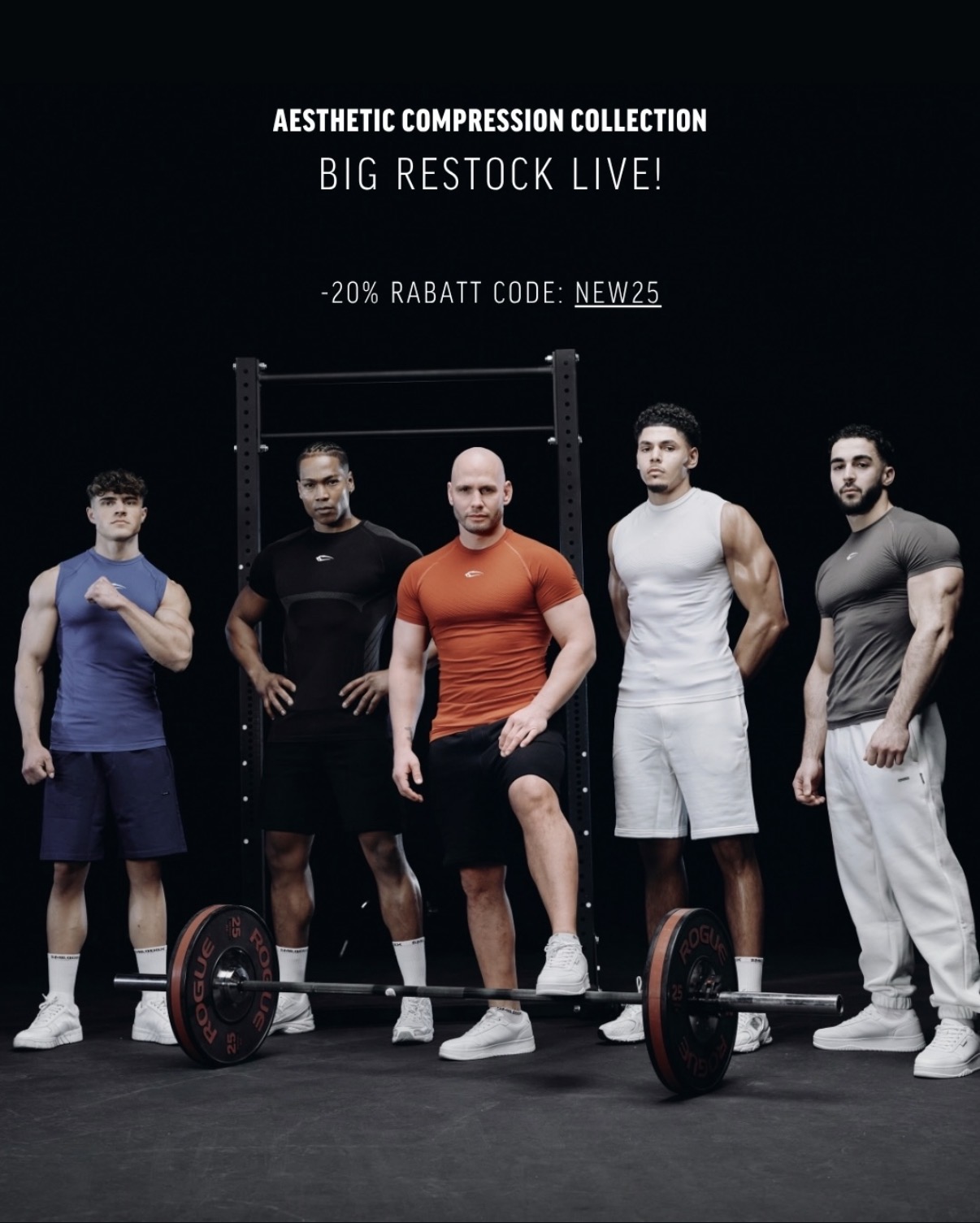
The Audiences
Four DACH segments Smilodox could plausibly buy media against, 30 agents each, 120 total:
- Strength-Training Female 22–32, DACH urban: trains 3–5x/week, lives in activewear, active on German fitness Instagram and TikTok.
- Male Aesthetic / Bodybuilding 18–28, DE urban + suburban: McFIT/Basic-Fit gym-goers, hypertrophy-focused, tight monthly budgets.
- Athleisure-Lifestyle Female 28–40, suburban Germany: wears activewear as everyday clothing, light exercise, shops Zalando and Otto.
- Combat-Sport / MMA Hobbyist Male 25–38, DE: trains BJJ, kickboxing or MMA, buys functional gear from Venum and Hayabusa. Included as a boundary case.
How We Ran It
Each agent was exposed to the creative across 40 simulated rounds and three placement contexts: Instagram in-feed weekday evening, Instagram Stories weekday morning, and Facebook News Feed weekend afternoon. Each context carried its own scroll environment, surrounding content, and dwell-time assumptions, so the ad was encountered the way it would actually be encountered: between competitor placements, while distracted, at different times of day.
Agents reacted the way real consumers do: scrolling past, stopping, posting, commenting, asking questions in threads, clicking, or ignoring. The simulation captured 727 actions and 269 expressive quotes, along with the felt response behind each. The emotion, the identity reaction, the unspoken barrier, and what the agent did next.
2. The Imago Score
The Imago Score is built from four scoring dimensions, each measuring something a campaign needs to do to actually work. For a single-creative test like this one, the four are weighted into a single overall number.
- Attention (20%): does the creative stop the scroll, and how deeply does it pull people in once it does.
- Conviction (30%): does it move people to take action, weighted by how meaningful each action is.
- Resonance (30%): when people react, do those reactions actually favour the brand.
- Reach (20%): does it land evenly across the targeted segments, or only in one corner of the audience.
Smilodox's overall score: 7.5 / 10. A strong headline number but the shape of the radar matters more than the average. Three dimensions sit at or near the top of the scale. One sits below five. That asymmetry is the story of this ad.
Attention · 7.93
Attention measures whether the creative earns a reaction at all. We track the share of exposed agents who engaged in any form (engagement rate), and the depth of that engagement (whether they glanced, stopped, or actively responded). Both are scored against placement-appropriate benchmarks and combined into a single 0–10 value.
The Smilodox creative cleared the scroll cleanly. 59.7% of exposed agents engaged with it in some form, well above what a cold-feed placement typically delivers, and the depth was high: when agents did stop, they tended to post, comment, or ask rather than just glance and move on. The black-on-black studio shot, the row of five colourways, and the "RESTOCK LIVE" headline do their job at the visual layer.
Conviction · 9.0
Conviction measures whether the ad moves people to do something, not just feel something. Every action an agent takes, comment, post, click, like, repost, follow, is weighted by how meaningful that action is, then summed per agent and scored. A comment counts more than a like; a click counts more than a comment; a "do nothing" counts for zero.
The creative produced a weighted action density of 6.22 per eligible agent, strong enough to ceiling the dimension. Across the panel, agents produced 75 original posts, 74 comments, 103 likes, 40 click-throughs, and only 17 do-nothing reactions. This ad does not get scrolled past. It moves people to act, though as the next dimension will show, "acting" and "acting favourably" are not the same thing.
Resonance · 4.75
Resonance measures whether the reactions the ad produces actually favour the brand. We classify every reaction as positive, neutral, or negative, weight them, and score the net. A creative can generate huge volumes of attention and conviction and still fail here if a meaningful share of that volume is hostile.
Of 727 classified reactions, 20.4% came back negative against 15.5% positive, with the bulk neutral. The mean sentiment landed slightly below zero (-0.05), and the dimension was flagged as elevated-risk: 148 reactions were classified as actively unfavourable rather than mild critique. The creative is winning attention and conviction, and a meaningful share of that attention is being spent on reactions Smilodox would not want to read. The "what went wrong" section will unpack where they're coming from.
Reach · 7.74
Reach measures whether the creative lands evenly across the targeted segments, or whether one group is carrying the result while others are excluded. We score the spread of performance across persona groups, penalising creatives that work for only a slice of the intended audience.
Smilodox landed evenly. The lowest- and highest-scoring groups sat within 0.44 points of each other on the per-group lands scale, with a standard deviation of 0.17 across the four segments. No segment was carrying the result alone, and no segment was being entirely missed. Reach being this high means the resonance gap is not concentrated in one corner of the audience, it's distributed across the panel. The deep-dive section will show where it concentrates and where it doesn't.
The Score in One Line
Smilodox's ad is winning the parts of the funnel that get measured by every other tool on the market, attention, conviction, reach, and losing the part most of them can't see. That's the asymmetry the Imago Score is built to surface, and the rest of this report is about where the resonance gap lives, what's driving it, and what it means for the segments Smilodox is actually trying to reach.
3. What the Reactions Actually Showed
The Imago Score told us that Smilodox is winning attention and losing resonance. This section is about what that resonance gap actually sounds like, what emotions the creative pulled out of the panel, what those emotions caused agents to do, and where the leverage sits to close it.
- Click-Through-Rate: 2,61 %
- Engagement Rate: 59,7 %
- Sentiment-Verteilung: 15,5 % positiv · 64,0 % neutral · 20,4 % negativ
The two emotions doing the most work across the panel ran neck-and-neck: skepticism at 28.1% of classified felt responses, and curiosity at 24.1%. The creative is interesting enough to wonder about and untrustworthy enough to question, at the same time, in the same agent, often in the same sentence. That tension is the engine of everything else in the data. It's why engagement was high (people were intrigued enough to react) and why sentiment was net-negative (their reactions kept landing on the skeptical side of the line). Behind those two: indifference at 15.9%, irritation at 14.1%, amusement at 6.6%, desire at 5.0%, distrust at 4.0%. Trust as a felt emotion appeared in 0.8% of reactions.
"The collection genuinely looks strong, 'performance that you see and feel' is exactly what I want from my gym kit. Hope they're not gone again immediately."
Strength-Training Female 22–32"Smilodox again? Was sold out, now it's back. Sounds like the classic scarcity move, doesn't it?"
Strength-Training Female 22–32Same product, same week, same audience segment, two agents standing on opposite sides of the same creative. The ad is sorting the panel cleanly. The trouble is what each pile then does next: the believers ask questions and tag friends; the skeptics post and move on.
Where the skepticism concentrated
Three barriers carried most of the resistance: missing facts (9.2%), category mismatch (8.9%), and trust gap (7.4%), with price anxiety close behind at 7.2%. The category-mismatch finding is the most interesting of the four, it means a meaningful share of the panel registered the creative as not aimed at them, which has nothing to do with the copy and everything to do with who appears in the shot and what they're doing.
"Looks pretty stylish, but five male models, compression sportswear, I'm a woman who does yoga in the evening, this clearly isn't talking to me."
Athleisure-Lifestyle Female 28–40When agents took a position on whether the ad was for them, the split came in 13.3% "for me" against 18.3% "not for me." Aspiration, the "I'm not there yet but I want to be" pull that drives a lot of sportswear conversion, appeared in just 1.2%. The ad isn't aspirational. It's identifying. It sorts the audience cleanly into two piles, and the for-me pile is the smaller one.
What to keep doing
- The visual is working. Five colourways, clean studio lighting, the barbell as a category cue, the creative does its job at the attention layer. Engagement and depth are both strong.
- Identity-led framing earns the second look. For the audiences who saw themselves in it, the creative translated into the panel's most active engagement, comments, posts, and questions rather than passive likes.
- The restock framing lands with warm audiences. Agents who recognised Smilodox treated "sold out, now it's back" as a credible scarcity signal and a reason to act. The framing only fails when the agent has no prior relationship with the brand to hang it on.
What to address
- The shot reads as a single-segment ad. Five men flanking a barbell tells half the addressable audience that the product isn't for them, regardless of whether women's pieces are available. Worth testing a variant of the same aesthetic register with mixed casting, keeping the studio look and the colour-block treatment, broadening who appears in it.
- One product fact would convert a lot of curiosity into clicks. Agents asked the same three questions across all four groups: is it squat-proof, how does it fit, what's the fabric. This is an aesthetic ad and should stay one, but a single line of supporting copy answering even one of these would close a meaningful share of the curious-but-skeptical reactions.
- Pricing on the creative is a separate conversation. Several segments flagged the absent price, and a starting price would do real work for the budget-anxious cohorts, but it's a brand-positioning decision, not a clean creative fix. Worth weighing rather than acting on by default.
4. Inside the Four Groups
Ranking the four segments by composite Imago Score, how the ad actually performed against each, the order is:
- Athleisure-Lifestyle Female 28–40: 8.01
- Strength-Training Female 22–32: 7.79
- Combat-Sport / MMA Male 25–38: 7.32
- Male Aesthetic / Bodybuilding 18–28: 6.58
"Athleisure-Lifestyle Female 28–40"
Athleisure-Lifestyle Female 28–40 topped the panel and also carried its largest unrealised audience. Highest positive sentiment (19.3%), lowest negative (12.1%), and the most question-asking behaviour of any group. The unique signal here was exclusion: the all-male casting drove most of the panel's category-mismatch reactions: "I'd need an Aesthetic Compression Set for myself too. Shame only men are shown." The ad earned warmth from a segment it wasn't designed to address. Worth thinking about whether to address them deliberately.
"Strength-Training Female 22–32"
Strength-Training Female 22–32 is the closest to a core audience the panel produced. Identity fit was the highest in the panel ("for_me" at 18.5%), and the dominant impulse was ask, agents tagging friends, debating fits, asking the same product question round after round: "Are they squat-proof? That's the most important test." Curiosity-led, warm, and ready to convert if the ad gives them one functional anchor.
"Combat-Sport / MMA Male 25–38"
Combat-Sport / MMA Male 25–38 is the group that broke from the consensus. By composite score it sits in the middle of the pack, but its sentiment profile was the panel's most negative by a wide margin: 30.4% negative against 12.4% positive, with skepticism at 38.2%. The creative's aesthetic-led register read as the opposite of functional, and agents named Venum, Hayabusa, and Fairtex as the trusted alternative repeatedly. "My gear has to hold up in sparring, not just look good on TikTok." This isn't a creative-tweak finding, it's a targeting one. Worth questioning whether the segment belongs in the media plan for this creative at all.
"Male Aesthetic / Bodybuilding 18–28"
Male Aesthetic / Bodybuilding 18–28 scored last but engaged most. Highest CTR (3.76%), highest amusement (11.5%), highest mockery rate. Price anxiety dominated as the single largest barrier in the panel (20.3%). They make fun of the ad and click through it anyway, an audience that's clearly in-target but signalling that the value question needs to land before the conversion will.
The Bottom Line
The Smilodox restock creative is a strong piece of work that earns attention, drives action, and lands evenly across its intended audience and underneath that strength sits a resonance gap, a misread combat-sports segment, and an unrealised female audience the brand wasn't aiming for but already has. None of that would have surfaced from a real-world media test reporting CTR and engagement, which would have called the creative a clear winner and let the targeting and casting questions surface only after months of spend. Imago surfaced them in days, against 120 simulated consumers, before a single euro went to media.