1. The Setup
The Ad
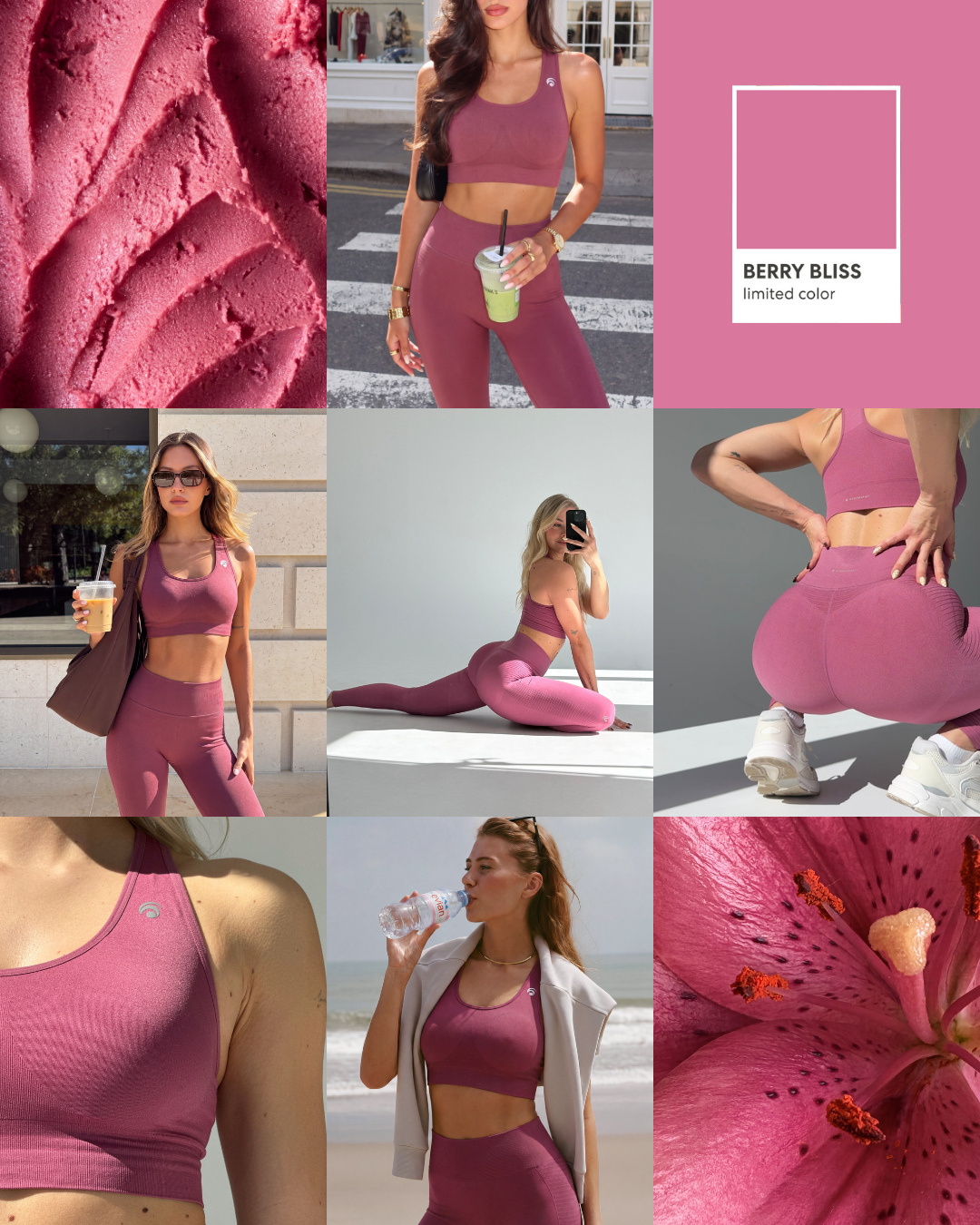
"flowers are blooming, and so are we 🌸 The Beverly Set in berry bliss 💕"
that's the full copy. no price. no CTA. a single static 9-tile mood-board image at 4:5, running as an in-feed placement on @oceansapart.de for DACH audiences, with the only product signal being a color name and a seasonal feeling.
The Audiences
Four DACH segments, 30 agents each, 120 total. each one represents a meaningfully different type of woman this ad was likely to reach.
- Aesthetic-led DACH Everyday-Wear Buyer: Mid 20s to early 30s, German metro cities. activewear as daily outfit, not gym kit. follows DACH lifestyle creators, buys a full set once or twice a year, values aesthetic coherence above most other things. the closest thing to a core target for this creative.
- DACH Yoga / Pilates / Home-Workout Participant: Movement is identity, not hobby. 2–4 sessions a week. evaluates on fabric feel and seamless construction. has a functional opinion on what she buys and why.
- TikTok-First DACH Creator-Content Follower: younger, creator-driven discovery, platform-native. engages fast, moves on fast. more likely to save and share than deliberate over a purchase.
- Returning Older DACH Activewear / Loungewear Buyer: older, more considered, stronger price-value lens. the group most likely to ask harder questions and weigh durability over seasonal cues.
How We Ran It
Most ad tests so far have tested frequency, how does the same audience react after repeated exposure? This run does something different.
Each of the four exposure contexts was treated as a fresh first impression. agents entered without memory of prior interactions. The goal was to stress-test whether this creative earns attention across genuinely different life moments and whether that holds across all four groups or collapses in specific conditions.
The four contexts:
- Tuesday morning, 7:35: phone in hand during the commute or morning coffee. 0.8–1.8 seconds average dwell per post. low attention, task-switching. first impression.
- Tuesday lunchtime, 12:50: desk break or office canteen. 1.5–3.5 seconds. moderate attention. The only context configured as a repeat impression, agents here had already seen the creative in the morning slot.
- Wednesday evening, 21:15: sofa or bed, winding down. 2.5–5.5 seconds. longer dwell, lower task load. first impression for a separate cohort.
- Saturday late morning, 10:55: leisurely brunch scroll. 2.0–4.5 seconds. relaxed pace, unhurried. first impression.
Within each context, agents were exposed to the ad and could react or not. Those who reacted could post, comment, like, click through, search for the brand, save privately, or do nothing at all. Agents also responded to each other's posts across rounds: a thread sparked replies, a shared post drew secondary reactions, a sceptical comment shifted the tone around it.
2. The Imago Score
The Imago Score is built from four scoring dimensions, each measuring something a campaign needs to do to actually work. For a single-creative test like this one, the four are weighted into a single overall number.
- Attention (20%): does the creative stop the scroll, and how deeply does it pull people in once it does.
- Conviction (30%): does it move people to take action, weighted by how meaningful each action is.
- Resonance (30%): when people react, do those reactions actually favour the brand.
- Reach (20%): does it land evenly across the targeted segments, or only in one corner of the audience.
OceansApart's overall score: 5.9 / 10. The number tells part of the story. The shape behind it tells the rest. two dimensions sit well above the midpoint. two drag it down. That asymmetry is where the useful information lives.
Attention · 8.66
Attention measures whether the creative stops the scroll and how deeply it pulls people in once it does. When agents stopped, they tended to post, comment, or ask rather than glance and move on. The depth was high.
The berry bliss mood-board earns a pause. That's the creative's clearest win and the most consistent finding across all four groups and all four contexts. Whatever else this ad does or doesn't do, it gets seen.
Conviction · 7.1
Conviction measures whether the ad moves people to do something, not just feel something. Every action is weighted by how meaningful it is, a click counts more than a comment, a comment more than a like, a do-nothing counts for zero.
This is where the gap opens up. commitment share sat at 10.6%, deliberation share at 18%. Agents noticed the ad at an above-benchmark rate and then a smaller share than the attention score would predict took any kind of meaningful next step. The creative earns the pause and generates genuine goodwill, it just doesn't consistently earn what comes after. Agents who engaged positively tended to save or share rather than click, which is the behavioural signature of inspiration content doing its job at the wrong point in the funnel.
Resonance · 4.09
Resonance measures whether the reactions the ad produces actually favour the brand. Of 479 classified actions, 34.5% were emotional. Of those, 69.7% were positive in direction. The sentiment split overall was 24.6% positive, 67.1% neutral, 10.7% negative.
The high neutral share is the signal here, not the negative. agents absorbed the aesthetic without committing to a feeling. The ad generated warmth in the right conditions and mild price friction in others, but no backlash, no brand-damaging actions anywhere in the data. It's not a polarising creative. It's an inspiring one that stops short of moving people.
Reach · 7.1
Reach measures whether the creative lands evenly across the targeted segments, or whether one group is carrying the result while others are left behind.
OCEANSAPART landed broadly. All four groups scored between 5.0 and 6.1 on the per-group lands scale, with a spread SD of 0.43. No segment was carrying the result alone, and none was being missed entirely. That's a genuinely flat profile for a warm audience, the ad doesn't work for one corner of the room and fall flat in the others.
One context-level note: the lunchtime slot produced the strongest reach score at 7.76, the weekend the weakest at 3.86. That gap will matter for the group deep dives.
3. What the Reactions Actually Showed
The numbers first.
Engagement rate: 66.4%, well above cold-feed norms for a warm audience. CTR: 1.82%. Sentiment split: 24.6% positive, 67.1% neutral, 10.7% negative.
Those top-line figures tell a consistent story: this ad gets engaged with. The negative share is low and produced zero brand-damaging actions anywhere in the data. The CTR is modest but sits in line with what a mood-first, no-CTA static typically delivers when the primary job is brand and awareness, not direct conversion.
The two emotions doing the most work across the panel were desire and curiosity, often arriving together, often in the same agent, often in the same reaction. The colour landed. Agents stopped, registered the aesthetic, and felt something positive about it.
"berry bliss is such a gorgeous name! 🌸 I love the mood-board vibe, very spring vibes."
"omg this color is EVERYTHING 🍇💕, I love the matching set vibe, perfect for uni days or a café run with the girls."
"the Beverly Set in berry bliss again, that colour is really growing on me, it's somewhere between a muted berry and a soft mauve."
Desire and curiosity together produce a specific behavioural signature. agents who felt them tended to save, share, or ask, not click. The save impulse appeared consistently across groups, the ask impulse appeared immediately after: agents who wanted the product wanted more information before they'd go further.
Scepticism entered as a secondary layer, not a primary one. it wasn't about the brand or the aesthetic. it was about the gap between what the ad looked like and what agents needed to act on it. The mood-board format earned warmth and then withheld the product details that would have converted that warmth into something downstream.
What the ad did well
- The colour earned genuine desire. Across all four groups and all four contexts, Berry Bliss generated positive first-impression reactions at above-baseline rates. Agents described it as spring-appropriate, aesthetically coherent, personally relevant. The colourway did the heavy lifting the copy set up and it delivered.
- The set framing registered clearly. Agents understood this was a coordinated buy. "matching set" language appeared organically in reactions across every group, agents framed it as a complete outfit, not a separates purchase. That matters for AOV and for how the product sits in someone's head after seeing it.
- The aesthetic matched the audience. The mood-board format felt native to the feed these agents scroll. Reactions described it as "inspo content," "very Pinterest," "exactly my saved tabs", which is high praise for brand alignment, even if it created a conversion gap. The ad didn't feel like an ad to a meaningful share of agents on first impression.
- No backlash, no brand damage. The negative share stayed controlled and produced nothing brand-damaging. For a purely aesthetic creative with no product information, that's a clean result. agents who didn't engage simply moved on and didn't push back.
Where the ad fell short
The limited-colour urgency signal never activated. Berry Bliss is positioned as a limited seasonal colorway. That signal didn't land. agents who were warm to the product didn't react differently to the scarcity framing, "limited color" wasn't visible enough in the copy to create FOMO, and the copy itself ("and so are we 🌸") didn't carry any urgency. agents who were ready to consider a purchase weren't pushed toward a decision.
Price anxiety in the absence of pricing. The lack of any price signal left a share of agents, particularly in the younger and TikTok-first cohorts, unable to calibrate. the reactions here weren't hostile, they were frustrated: "not about to pay full price for leggings that might pill after 3 washes" and "need to know if there's a discount code dropping soon." this is a fixable gap. a sale-price signal, a subtle "from €71.99" line, or a visible code would have closed a meaningful share of these loops.
The weekend context underdelivered. Agents with more time to evaluate were more likely to notice what the ad was missing rather than be carried along by the aesthetic. The weekend imago score (4.10) was meaningfully lower than any weekday context. More dwell time cut both ways, it allowed agents to appreciate the visual and then immediately ask the questions the creative couldn't answer.
4. Inside the Four Groups
"Aesthetic-led DACH everyday-wear buyer"
This is the group the ad was most designed for, and the most interesting tension in the dataset: nobody paid more attention, and nobody converted less.
Attention was maxed out in every single context, 10/10 in three of the four slots, with response rates between 27% and 39% depending on when the ad found them. These agents stopped, engaged, posted, shared. By attention alone, this creative is perfectly calibrated for this group.
What they did with that attention is the finding. 94 of their 193 total actions were to create a post, the highest post-share of any group. They shared the aesthetic outward. They didn't click inward. CTR came in at 1.15%, the lowest of the four groups. conviction scored 1.50 across the panel, by far the weakest.
"this is so aesthetic! saving for inspo 🌸"
"wait, is this an ad? the tiles are confusing. I thought it was a home decor post at first."
Those two reactions, appearing together, describe this group's entire arc: aesthetic recognition, immediate save, then a stall at the product layer. The format confusion quote is worth noting, the 9-tile mood-board was most likely to be misread as lifestyle content rather than a placement by this group specifically, because they consume more of that format than anyone else. it earned attention precisely because it looked native. that same quality meant a share of agents didn't register it as something to act on.
Context shifted the texture but not the direction. Morning was rushed and produced the most raw post volume. Lunchtime generated the strongest resonance score for this group (5.51) and slightly more deliberate engagement. evening produced warm reactions but the same save-not-click pattern. The weekend was the most emotionally mixed, higher negative share and more price friction than any other context for this group.
What this tells you for the brand. The aesthetic-led buyer is already doing OCEANSAPART's distribution work, she shares the creative, saves it, and circulates the aesthetic. The brand is getting organic amplification from this group without earning the click. A sale-price signal in the weekend slot specifically would address the price friction that surfaces when she has time to think about it.
"DACH yoga / pilates / home-workout participant"
The most conversion-ready group in the run, and the one that got closest to the product without quite reaching it.
Engagement was deliberate throughout. This group had the highest CTR at 3.81%, the most balanced action mix, private impressions, considered comments, deliberate likes, and the cleanest conviction scores in the morning context (6.63, zero negative actions).
When they engaged they did so with intent, not just aesthetic appreciation.
The emotion doing the most work here was desire, and it was specific. These agents wanted the set for a reason they could name: spring studio sessions, reformer flow, matching-set everyday. Their ask was the same across every context and every round: is it seamless, what happens at the waistband in a forward fold, does the fabric hold up after washing.
"berry bliss sounds gorgeous for spring studio sessions 🌸 but I'm with the others, would love to see how this actually fits! how's the waistband seam situation? that's make-or-break for me in forward folds."
"I need to know how the fabric feels during reformer Pilates, not material details, not texture, not weight. that folded-forward position in a chest opener can be brutal if the fabric isn't right."
"The colour is really growing on me. not quite ready to tap the shop button without knowing the material weight."
The lunchtime repeat-impression context produced this group's strongest numbers, conviction 6.89, resonance 5.50, composite 6.23. A second look with more time to evaluate moved them closer. The morning first-impression context was nearly as strong: conviction 6.63, zero negative actions, 100% positive sentiment among active agents.
The weekend context was notably weaker (composite 4.43), the relaxed pace worked against this group by giving them more time to notice what the ad was missing rather than be carried along by the visual.
What this tells you for the brand. This group is one product detail away from converting. They're not price-sensitive in the way the younger groups are, they're information-sensitive. A single piece of fabric or construction copy, "seamless, no front seam, waistband tested for forward folds", would close a meaningful share of their stall. Retargeting this group after a first impression with a creative that adds any movement context would be unusually efficient.
"TikTok-first DACH creator-content follower"
The group that surprised the most, and the one with the sharpest context dependency in the entire dataset.
By conviction score they were the second strongest group overall (4.76), and in the morning context, they were the strongest of all four groups (5.51). Their action mix had a higher share of meaningful engagement, click-throughs, private research, active deliberation, than their surface persona would predict. They also had the highest resonance (4.84) and the cleanest positive-direction score among emotional reactions (80%). When this group felt something, it skewed positive by a wide margin.
"OMG this set is SO cute 😍🌸 the colour is perfect for spring and the Beverly cut looks mega comfortable! directly sent to my friend to see if we can wear it matching!!"
"omg this color is EVERYTHING 🍇💕 I love the matching set vibe, perfect for uni days or a café run with the girls. kinda want to check it out but my wallet is screaming rn 😅 anyone know if there's a discount code floating around?"
Then the weekend happened. composite score collapsed to 2.79, the lowest single group-context pairing in the entire run. Resonance was flagged as risk, with brand-damaging actions appearing. Negative share spiked to 25%. The relaxed Saturday scroll gave this group time to become critical in a way the fast-moving weekday formats didn't.
The shift isn't a change in who they are, it's a change in what mode they're in. fast scroll, reactive, creator-influenced: this ad works. slow scroll, evaluative, Saturday brunch: the same ad reads as evasive.
What this tells you for the brand. weekday-only scheduling for this group. The morning and evening slots are where their conviction and resonance are genuinely strong, the creative fits how they consume content in those contexts. Weekend spend on this segment is at best wasted and at worst generating the kind of reactions you don't want amplified.
"Returning older DACH activewear / loungewear buyer (boundary)"
The boundary group, included precisely because the creative wasn't designed with them as primary, and the data confirms they're the hardest group to land, but not because they don't respond to the product.
Their most striking feature is context sensitivity. Morning and evening were middling (4.44 and 4.90). The weekend was poor (3.61). but lunchtime was 6.82, the single highest group-context score in the entire run, with conviction at 8.25, zero negative actions, and 100% positive sentiment among active agents. The same group that under-delivered in every other context converted cleanly in one specific window.
What the lunchtime context gave them that others didn't: a relaxed, browsing mindset without the heightened scrutiny of an open Saturday morning. They weren't rushed like the morning cohort, and they weren't in extended evaluation mode like the weekend cohort. They were in a desk-break state where the aesthetic was enough to carry them, and crucially, where they weren't comparing it to their existing wardrobe or running a durability calculation.
The berry-bliss seasonal framing, spring drop, limited color, also landed less warmly with this group than with younger agents. A seasonal colour drop reads as excitement to a 26-year-old and as "it'll be gone when I need to replace it" to someone older.
What this tells you for the brand. The brand can reach this group, but the window is narrow. The creative gap is different here than for the other groups: not a fit shot, not a discount code, but something that signals durability and product longevity. A single fabric composition line, a wash-count claim, or a "bestseller" label would do more work for this group than anything that speaks to seasonal colour. if targeting this segment deliberately, a separate creative with that emphasis would outperform the current one significantly.
The Bottom Line
The Berry Bliss Beverly Set earns attention cleanly and generates genuine warmth, the colour works, the aesthetic lands, and the panel produced no backlash worth worrying about. What it doesn't do is close the loop: the mood-board format earns the save and stalls at the click, and different groups stall for different reasons. None of those are fundamental creative problems. They're specific, fixable gaps.
What's notable is that all of it, the group-level divergence, the context sensitivity, the exact friction points, surfaced here before a single euro went to media. That's what Imago is built to do: compress months of in-market learning into days, so the decisions that usually get made after the spend get made before it.